


1982年,法比奥·齐里菲诺(Fabio Cirifino)、保罗·罗萨(Paolo Rosa)和莱奥纳多·桑焦尔吉(Leonardo Sangiorgi)开始了他们探索技术新文化想象力和表达力的经历。1995年斯特法诺·罗维达(Stefano Roveda)加入了他们的队伍。通过制作环境影像、敏感和互动环境、陈列展示、戏剧表演和电影,划出了一道横跨各类传统表现方式的艺术之路,形成了吸纳众多专业人士的贡献并与他们开展重要合作的工作组。
一开始,他们的艺术探求集中在环境影像方面,他们开展了将电子形象和自然环境相互补充的实验,力求达到使观众和其中的感知途径成为中心的目的。环境影像是以极富内涵的场景、很多组重复性的小事件的录像镜头、有助于打破屏幕限制的显示器组合为基础的叙事装置。在《游泳者》(去海德堡的次数太频繁,1984)和《视野》(那个人从来不停息,1985)等作品中,采用了人的形象元素和自然的元素,按照应该接纳它们的空间和社会环境进行设计制作。
在那些年里,为第八届卡塞尔文献展创作并获得Ubu大奖的《抽象的房间》(1987)等各种戏剧作品的制作,推动了他们在戏剧和表演范围内的研究,凭借以演员的身体和录像的虚拟空间之间的相互作用为基础的双场景的发明,找到了戏剧情节与录影形象之间相互补充的原始方式。实验在随后的几年里继续进行,就舞蹈剧和音乐剧的课题展开,其中在伦敦艾尔美达剧院(Almeida Theatre)上演的《颂西公爵》(1997)堪称这一时期的代表作。
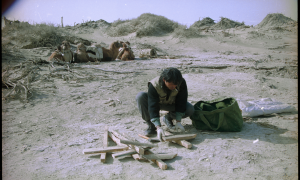
同时凭借《纳诺夫先生的核心观察台》(1985),蓝色工房继续开创电影方面的事业,出品了电影长片《记忆师》(2000),这是改编自神经心理学家鲁利亚(A.Lurija)叙述的一宗迷人的临床案例,电影里自由谈起在错综复杂的记忆里的一段旅行。
1995年蓝色工房投入到了一项新的、极其重要的关于互动和多媒体的领域,制作了《敏感的环境》 的一系列作品,如《桌子》(为什么这些手都来碰我?1995)和《合唱》(1995)。这是一些能够对处于其中的人发出的刺激产生反应的环境,其中技术与叙述和空间融为一体,其产生的效果来自更多的人的选择和存在,而器械装置通过“自然界面”,不靠技术手段,而是通过普通的具有感染力的方式,比如触摸、践踏或发出声响等而起作用。
2002年,在结束了两年的研究和旅行之后,在那波里的圣埃尔莫城堡(Castel S. Elmo)和东京森美术馆(Mori Art Museum)展出了《地中海沉思》, 这是包括以地中海特点为主题的“五处不固定风景”的互动影像装置展览。这部作品标志着一个关于土地及其记忆和特点的新的需求的开端,在多媒体博物馆设计上集中了过去的经验,如在萨尔扎纳(Sarzana)的《抵抗运动博物馆》(2000),在维纳迪奥阿尔贝蒂诺要塞(Forte Albertino, Vinadio)的《运动中的大山博物馆》(2007)。强大的叙述和浸入式部分,相关的和互动的接触,使这些博物馆表现出知识生态系统和叙述空间在与公众和虚拟社群的扩大对话中变化的特色。
这种与关于记忆、地点及社团价值的关注,明显影响了艺术路径,促使诞生了又一轮主题为《故事的传承者》的系列作品,在这些作品中,另一种互动形式被进行了实验:参观者以极其强烈的参与方式参与其中,通过某个地方的居民的叙述,发现这个地方。该项目正在进行中的头几部作品是在卡萨布兰卡推出的《敏感的地图》,在圣菲(Santa Fe)国际双年展上推出的《第四个梯子》,在2010年上海世博会上推出的《感性之城》。
尽管有很多人在这么多年里,或短期或长期地,贡献出了自己的想法及他们自己的感觉,蓝色工房仍然呈现出独一无二的个性,建造了其统一的创造性的环境,推动了这一特别的实验,并在这非常复杂的活动中保持了其深远意义的航向及连贯性。
目前蓝色工房与各类艺术人才合作,他们是:马可·巴索提尼、艾丽莎·薄丽丝、雷讷·布恩可、马泰奥·切利尼、马里奥·可齐米里奥、达涅莱·德·帕尔玛、艾丽莎·嘉尔迪娜·帕琶、弗朗切斯卡·戈洛、托马索·莱迪、卡门·雷欧帕尔蒂、基娅拉·丽姬、基娅拉·隆歌、茅罗·马切拉、阿尔贝托·马萨丽·贝尔诺基、达涅拉·梅泽拉、艾丽莎·米达丽、阿莱桑德罗·贝科拉罗、希尔维娅·佩丽扎礼、朱里奥·佩尔尼切、索妮娅·拉妮奥、罗伦佐·萨尔蒂。
STUDIO AZZURRO
In 1982 Fabio Cirifino, Paolo Rosa and Leonardo Sangiorgi began an experience which, over the years, has explored the poetic and expressive possibilities of new technological cultures; in 1995 they were joined by Stefano Roveda. Through the creation of video environments, sensitive and interactive environments, museum exhibitions, theatre performances and films, they have developed a broad artistic experience which cuts across traditional disciplines, forming a team which is open to various contributions and other significant collaborations.
Its artistic research was, at first, directed toward the creation of video environments, in which the electronic image became a part of the physical environment in order to give central importance to the spectator and the surrounding context. Video environments are narrative devices based upon a highly evocative scenario, upon recorded video sequences of short repeated events and upon an arrangement of monitors which makes it possible to avoid the limitations of the screen. Works such as Il Nuotatore (va troppo spesso ad Heidelberg, 1984) and Vedute (quel tale non sta mai fermo, 1985), involving the human figure and nature as their elements, are projected according to the spatial and social context in which they are to be viewed.
Various works during this period, such as Camera astratta (1987) – commissioned by Documenta 8 in Kassel and winner of the Ubu Prize – took their research into the area of theatre and performance, finding an original way of bringing together theatre action and video image with the invention of the double scene, based on the live interaction between the body of the actor and the virtual space of the video. Experimentation continued over the following years through theatre dance and musical, in which The Cenci (1997), presented at the Almeida Theatre, London, represented an important moment.
During the same period, Studio Azzurro’s cinema activity was further developed with L’osservatorio nucleare del sig. Nanof (1985), culminating in the release of the feature film Il Mnemonista (2000), a voyage into the labyrinths of memory, freely adapted from a clinical case described by Alexander Luria.
In 1995 they developed an important new interest in questions of interactivity and multimedia, with the creation of a series of works described as sensitive environments, including Tavoli (Perchè queste mani mi toccano?, 1995) and Coro (1995). These are environments which are capable of responding to a human action, in which technology is combined with narration and space, where the effects produced derive from choices and from the presence of people and systems, through “natural interfaces”, reacting without the use of technological controls but through ordinary means of communication, such as touch, foot contact or sound.
In 2002, after two years of travel and research, an exhibition entitled Meditazioni Mediterraneo was presented at Castel S. Elmo, Naples, and at the Mori Art Museum in Tokyo, consisting of five “unstable landscapes”, interactive installations on the theme of Mediterranean identity. This work was to mark the beginning of a new investigation into place, with its memory and identity, using the results of earlier experiences in order to design multimedia museum exhibitions, including Il Museo della Resistenza at Sarzana (2000) and the Montagna in Movimento museum (2007) in the Fortress at Vinadio. The strong narrative and immersive content, the relational and interactive approach, make these museums into ecosystems of learning, narrative habitats which form a dialogue with visitors and with virtual communities.
This contact with the values of memory, of places and of communities was also to have a notable influence on their artistic experience, with the production of a new cycle of works called Portatori di storie in which a highly participatory form of interactivity was tried out, involving the visitor, in order to explore the local area through the accounts of its inhabitants. The first works in this project, which is still being developed, are being presented in Casablanca, with Sensible Map, at the International Biennial at Santa Fe, with La quarta scala, and at Shanghai World Expo 2010, with Sensitive City.
Studio Azzurro works with a single mind, though it includes many people who have contributed over the years, for shorter or longer periods, with their ideas and their own personal skills and sensibilities, in order to build up a single creative atmosphere in which to develop this type of experience, making it possible to maintain a direction and a coherence of meaning in its widely varied activity.
Those currently working with Studio Azzurro in various roles include: Marco Barsottini, Elisa Bolis, Reiner Bumke, Matteo Cellini, Mario Coccimiglio, Daniele De Palma, Elisa Giardina Papa, Francesca Gollo, Tommaso Leddi, Carmen Leopardi, Chiara Ligi, Chiara Longo, Mauro Macella, Alberto Massagli Bernocchi, Daniela Mezzela, Elisa Midali, Alessandro Pecoraro, Silvia Pellizzari, Giulio Pernice, Sonia Ragno, Lorenzo Sarti.
【编辑:霍春常】





 京公网安备11010502038436号