


亚洲,究竟是一种文化意义上的概念呢?还是一种地理疆域的划分?
亚洲,能够被视为一个有共性的集体名词呢?还是一个单纯的地理方位的称谓?这样的讨论可以无止无休地进行下去,而且,永无结论。
但是,如果我们将亚洲,放在当代的语境中看待时,那么,东方亚洲长久以来始终分歧而多元的文化,和西方欧美经历比较具有共性的全面现代化过程而言,一种东西文化对比的关系似乎是存在的。
如果,我们从西亚、中亚地区横跨中国一大片疆土,连结了东亚、东南亚,然后延伸到南亚,即所谓的大范围的亚洲,那应该还包括了太平洋群岛,大约囊括了全世界人口总数的将近四分之三。欧美西方世界,尽管种族、语言是分歧而多元的,但是宗教上多数以原始基督教为源头的信仰发展,两百余年来的工业生产的现代化过程中,将各国世俗生活差异迅速拉近了,形成了一个比较具有共性的西方现代文化。然而,亚洲地区不但宗教信仰源头各异,语言文字体系更是十分复杂,到今天还普遍存在着风俗各异的传统文化,工业生产现代化是非常短近才发生的现况,而且发展程度有落差,在亚洲各国、各地区之间世俗生活的差异是巨大的,即使在高喊着全球化的今天,一个文化上分裂的亚洲,还是一个不争的事实。
若是单从亚洲的当代艺术角度切入的时候,一般还都是从西方人的眼光在看亚洲,所以总是挑捡出和西方现代化发展比较具有共性的那些部分而言,所谓的东方主义其实是一个贬抑词,往往忽视了亚洲地区对传统文化的实践,其实从来都不曾间断过,亚洲的过去,就是是现在的一部分。严格而言,在今天发生的,就应该都被视为亚洲的当代,亚洲当代多元文化的当代样式,产生的艺术就是当代艺术,而不只是与西方具有共性的那一部分而已。在亚洲的当代文化语境里,传统和现代不具备对立或取而代之的关系,即使谈不上是两者是共荣并立的关系,但也至少是一种数千年以来共生共存的生态。
当然,在亚洲国家和地区之中,日本的明治维新,使得世俗生活的日本文化,和欧美样式是比较接近了,但是,传统的书画和工艺仍顽强地生存在日本的当代文化之中。从西方现代主义艺术评论家克来曼·葛林伯格(Clement Greenberg)论点来看,即便是社会世俗生活已普遍现代化的日本,也还存在着前现代文化,甚至根本就是和现代对立的传统文化。葛林伯格认为的现代艺术具有一种定义明确的主流,这一点恰恰在亚洲是从未发生过的。换言之,过去从西方艺术世界看亚洲,亚洲当代艺术是边缘的,不曾进入过主流,应该是说不曾进入过“西方的”“主流。而同时,西方的现代艺术主流也从未真正霸占过亚洲的多元共生的主流。
我个人印象深刻的一次语言邂逅,场景在纽约,一位当地策展人听到我是从上海来的策展人,她劈头就问,在中国难道有当代艺术不是模仿我们西方的吗?这样的疑问,把中国换成亚洲,在她的心目中肯定也是成立的。这个问题的正本清源,归根究底,还是在于对当代艺术的定义是什么,是谁说的才算,或者是谁说了都可以算的文化话语权的角力。
近几年来,亚洲当代艺术的崛起,表面上看,好像欧美藏家的关注转向了亚洲的当代艺术,尽管有了几次交易活络,开出高价的拍卖会,事实上,离开西方当代艺术的交易平台,这还是一个小规模的起步,而且是巨大冰山的一角,真正的能量尚未释放出来。最初进场的西方买家,多数在面对异国风情的亚洲时,总喜欢以窥密搜奇的心理,以他们西方为中心的视野,选择了一些点缀他们生活的东方新鲜口味而已。近十年来,亚洲艺术家在国际双年展、三年展,或一些欧美的大美术馆开始出人头地,像中国的艾未未、蔡国强、陈箴、徐冰、张晓刚、方力钧,日本的草间弥生(Yayoi Kusama),村上隆(Murakami Takashi)、奈良美智(Yoshitomo Nara) 、小谷元彦(Odani Motohiko)、加藤泉(Izumi Kato),韩国的白南准(NamJune Paik)、徐道获(Do Ho SUH)、崔正化(CHOI Jeong-Hwa) 、李昢(LEE Bul)、金守子(KIM Sooja)、朴西浦(Park Seo-bo),印度的Anish Kapoor、Subodh Gupta、Jitish Kallat、Ravinder G. Reddy、Jiten Thukral和 Sumir Tagra双人组,印度尼西亚的Heri Dono、Agus Suwage、Budi Kustarto、Handiwirman Saputra、Nyoman Mariadi或泰国的Natee Utarit、Vasan Sitthiket、Rirkrit Tiravanija、Chatchai Puipia,几乎都成为亚洲当代艺术市场中的宠儿。
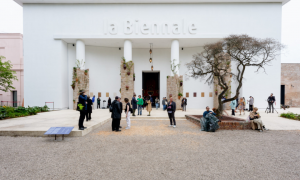
亚洲双年展、三年展的发展速度惊人,1993年澳大利亚举办了第一届亚太三年展,算是点燃了这把火,随之而后韩国的光卅、釜山,中国的上海、北京、广州、成都、深圳和中国台北,日本横滨、福冈,印度尼西亚的雅加达,和新加坡等等,办个双年展似乎成了亚洲的城市运动。亚洲年轻艺术家在强大的双年展圈子的影响下,出现一股模仿双年展观念性的影像、行为、装置艺术的风潮。在独立策展人群雄并起的时代,策展人像是一把双刃剑,一方面他们将亚洲当代艺术传播给全球的观众,但同时他们却不一定能够提供足够的学术研究资料,对外界认识亚洲当代艺术而言,有时还可能造成偏差或误导的认知。
有趣的是,亚洲经济的迅速发展,自然成了另一种平衡的力量,那就是亚洲艺术市场的崛起。双年展、三年展火爆发展的十年,也同时是亚洲画廊、艺术博览会和拍卖公司蓬勃发展的年代。这种由新兴艺术市场所带动的繁荣,自有一种供需之间的游戏规则,很难由少数人影响整个市场交易,而双年展、三年展那类大展,却是少数人即能主导掌控全局。亚洲的当代艺术进入市场化的阶段,其实至关紧要,那意味着亚洲当代艺术逐渐向国际流通的货币值靠近,艺坛的生物链才可能建立起来,和国际的互动关系才能真正达到平等。近两年,德、意、美、法、日、韩到中国来开画廊的数目增加了,特别是在北京的798、酒厂和草场地一带,北京是否能够形成亚洲最重要的交易平台,就要靠数字来说话了。
相对于艺术市场的日趋成熟,艺术史方面的学术研究仍十分薄弱,亚洲各国到今天为止都无法整合出一部像样的当代艺术论述。过去,亚洲文化的话语权基本上是附庸在西方强势文化之下,鲜见以亚洲立场撰写的史论著作。上一世纪前半期不少亚洲国家仍处于被殖民的状态,艺术创作的自我面目处于分裂的状态,保守的传统派往往和西化的现代派对立。到了下半世纪,从西方取经回国的艺术家,以西方为范本带动了当地的前卫艺术运动,从抽象艺术、行为艺术、观念艺术到新媒体艺术等等,面目、类种相当繁多,对文化自我认同意识的探讨也逐步升高。中国因为政治的因素,一直到了上一世纪80年代中期,才开始接触西方的前卫艺术理念。
然而进入了数字化的21世纪,人们从环境里获取知识的管道更便捷、多元而且普及。新世纪的亚洲艺术家总结了「观念主义」和「媒材处理」两方面的经验,采取更开放的对话方式,不但从历史中重新挖掘和建构新的诠释或立场,而且多重地选用全球各族裔文化间相异的特质,诉诸于艺术家个人的当代生活经验,不断拼凑、媒合、重组、再生,有的将性别课题也考虑在内。新世纪亚洲的当代艺术,无可避免地迈向了新折衷主义(Neo-Eclecticism),这种经由混合交配而产生的多元(heterogeneity)的视觉形式,其实也包涵了昔日一脉相承的传统艺术,并将之视为众多合成可能的其中选项之一。换言之,新世纪亚洲当代艺术的发展方向,不再是对立或全盘西化的两种选题。亚洲艺术家从上一世纪承受西方形式主义排山倒海而来的渗透,迷惘、愤怒、慌乱的经历逐渐沉静下来,才能以自省的姿态重新调整发展的方向。亚洲的当代艺术如今所面对的是创作态度的普遍改变,风格与形式都已不是最首要的。
来自于台湾的索卡艺术中心,度过18个年头,是台湾最早到内地发展的画廊。今年4月北京索卡艺术中心迁往798艺术园区,开馆展以亚洲为定位再出发,一方面显示创办人萧富元一路走来的心路历程,另一方面宣示本展共同策展人萧博中,索卡少主接班运营的方向,将以亚洲为蓝图,展出8国31位国际著名的艺术家的作品,一方面是索卡艺术中心的馆藏,一方面由策展人邀约艺术家参展。主题『云端』取自于最近很热门的云端运算(Cloud Computing)科技,意味着索卡艺术中心向20周年迈进的自我期许。
Clouds:
The Position of Contemporary Asian Art
Victoria Lu
Can Asia be reasonably considered a culturally significant concept? Or is it nothing more than the designation of a geographical area?
Can Asia be viewed as a collective the members of which share certain things in common or is it nothing more than a simple signifier or topographical marker? Unfortunately, this is one of those debates that could go on ad infinitum without ever reaching a conclusion.
Looked at through the language of modernity Asia has always encompassed a great diversity of cultures both modern and traditional, whereas the countries of Europe and the US underwent modernization at or around the same time. This clearly constitutes an important difference in terms of eastern and western culture today.
Even the simple task of defining Asia is problematic. If we begin in western and central Asia and travel across the vastness of China we reach East Asia and South East Asia. It is then possible to continue all the way to South Asia and perhaps even the Pacific islands - a land mass that is home to almost three quarters of the population of the planet. Despite the fact that there are many different races and languages in the western world, the belief systems of most developed from original Christianity. In addition, the process of modernization brought about by over two hundred years of industrial production has served to reduce if not entirely eliminate differences in national habits and customs. It also created a modern western culture that contains mainly commonly held elements and values. By comparison, not only do the origins of the many religions in Asia differ markedly, the mixture of languages and written scripts make the area an often ridiculously complex cultural mosaic. On top of that, traditional cultures with completely different customs continue to exist throughout the area and in many cases, modernization facilitated by industrial production is something that only happened very recently and is still ongoing. Moreover, there are also great differences in the level of development in different places, so that all over Asia the differences in secular life between countries and even regions can be enormous. Even today, at a time when editorials and commentaries are often filled with globalization-related angst, the cultural fissures that run through Asia remain an undeniable fact.
If we approach this problem from the point of view of contemporary art in Asia then there has in the past been a tendency to look at Asia through western eyes. Unfortunately, this results in a situation where certain are cherry-picked because they share something in common with the development of western modernism and in such a context the term “Orientalism” becomes derogatory. This is an attitude that entirely overlooks the unbroken reality of traditional culture all over Asia, the fact that in large swathes of Asia the past remains very much an integral part of the present. Strictly speaking anything that happens today should be considered part and parcel of modern Asia. Art created from the diversity of modern Asian culture is by definition contemporary art, not just that part that shares something in common with the west or western experience. In the language of contemporary culture, tradition and modernity in Asia are not juxtaposed or mutually replaceable. Even though it is not strictly possible to speak of them flourishing in unison, they have at the very least symbiotically coexisted for several millennia.
When looking at the countries of Asia Japan immediately stands out in as much as the Meiji Restoration (1868) ensured that temporal life in Japanese culture drew closer to forms more familiar in the west. However, traditional painting, calligraphy and handicrafts remain to this day a resolutely strong part of contemporary Japanese culture. Indeed, western modern art critic Clement Greenberg has commented on this apparent contradiction, wherein although secular life in Japan is thoroughly modernized, pre-modern and even traditional culture that stand in complete juxtaposition to modernity continue to exist In Greenberg’s writings modern art possesses a clearly defined mainstream, but this is something that never occurred in Asia. This underscores why in the past the western art world viewed Asia and contemporary Asian art as peripheral, something that had never been part of the mainstream or more accurately the “western mainstream.” By the same token it is also true to say that the western modern art mainstream never really replaced or defeated the mainstream of diversity and coexistence that exists in Asia.
I would like to relate a strange encounter I experienced in New York once because I think it sheds light on this issue and it had a profound impact on me personally. A local curator had heard that I was a curator from Shanghai and was keen to engage me in conversation. Cutting to the chase she came straight out and asked me if there was any contemporary art in China that didn’t simply copy that produced in the west? I think that for that particular curator and many other likeminded people this is a question that applies not just to China but all Asia. While the origins of this way of thinking have a long and often unpleasant history they can be traced back to a struggle over who has the right to speak for a culture as to what constitutes contemporary art, who has the authority to make such a declaration and whether are all voices equal?
Superficially, the recent rise of contemporary Asian art appears to have attracted the attention of collectors from Europe and the US, but despite an increase in the level and frequency of transactions and high prices at auctions, the truth is that this is a small and tentative first step away from western trading platforms for contemporary art. Moreover, it is also just the tip of the iceberg with the real energy hidden beneath has yet to be released. Faced with the exotic customs of Asia the earliest western buyers behaved almost as if they were uncovering buried secrets or searching for strange wonders rather than collecting modern art. Based on their obviously western-centric tastes, they generally did little more than select a few fresh Eastern baubles with which to decorate their lives. However, over the last decade Asian artists have started to make a name for themselves at international biennials, triennials and some of the major museums in Europe and the US. Examples include from Ai Weiwei, Cai Guoqiang, Chen Zhen, Xu Bing, Zhang Xiaogang and Fang Lijun from China; Yayoi Kusama, Murakami Takashi, Yoshitomo Nara, Mariko Mori and Yasumasa Morimura from Japan; Nam June-paik, Do Ho-suh, Choi Jeong-hwa, Lee and Bul, Kim Sooja from South Korea; Anish Kapoor, Subodh Gupta, Jitish Kallat, Ravinder G. Reddy and the art duo Jiten Thukral and Sumir Tagra from India; Heri Dono, Agus Suwage, Budi Kustarto, Handiwirman Saputra and Nyoman Mariadi from Indonesia; Vasan Sitthiket, Rirkrit Tiravanija and Chatchai Puipia from Thailand. These artists have nearly all become stars in the contemporary Asian art firmament.
The rate at which art biennials and triennials have appeared across Asia has really been quite breathtaking. This particular prairie fire can be traced back to the 1st Asia-Pacific Triennial held in Australia in 1993. In the years since then, organizing biennial art exhibitions seems to have become something akin to a badge of honor, an urban movement embraced by cities across Asia: Guangju and Busan in South Korea; Shanghai, Beijing, Guangzhou, Chengdu and Shenzhen in China; Chinese Taipei; Yokahama and Fukuoka in Japan; Jakarta in Indonesia and Singapore. Strongly influenced by this upsurge in eye-catching art biennials, many young Asian artists have started copying the conceptual video, performance and installation art showcased at these biennials. At a time when there has also been a dramatic increase in the number of independent curators, being a professional curator has become something of a double-edge sword. On the one hand they introduce contemporary Asian art to a global audience, but on the other that is not to say such curators are able to provide enough academic research work. When it comes to the outside world better understanding contemporary Asian art, it may well be the case that some curatorial work can lead to misunderstandings based on discrepancies and misdirection deliberate or otherwise.
Interestingly, the rapid development of Asian economies has created a natural counterpoint through the rise of the market for Asian art. A decade of explosive growth in biennials and triennials has led to an equally heady expansion of art galleries, art fairs and auction houses across Asia. The prosperity this new and rising art market has created comes with its own rules of supply and demand that make it difficult for a small number of people to manipulate the market, whereas large exhibitions still tend to be controlled by a small handful of individuals. This period of market-oriented development signifies that contemporary Asian art is gradually becoming a currency of international exchange, which both facilitates the creation of a lasting art community and implies that the relationship with the international art community really is becoming one of equals. Over the last two years the number of operators from Germany, Italy, United States, France, Japan and South Korea opening galleries in China has dramatically increased, especially in Beijing’s 798 Art Zone. As to whether Beijing will become the most important art trading/business platform in Asia, only time will tell.
Compared to the increasing maturity of the Asian art market, there remains a clear paucity of academic research into art history. Even today, Asian countries have so far found it impossible to put together a comprehensive commentary on contemporary art. In the past, the right to talk authoritatively on Asian culture was basically subsumed by western culture, so very few history books were ever written from an Asian perspective. Indeed, for the first half of the twentieth century many Asian countries were still colonized by the west with self-image of local art ruptured, wherein conservative tradition always stood in juxtaposition to westernized modernists. By the second half of the century many artists educated in the west returned home and learning from the west encouraged local avant-garde movements; from abstract to performance art, from conceptual to new media art etc. In terms of appearance and type, these movements were highly diverse and gradually became much more important as vehicles for cultural self identity and awareness. For political reasons, China first came into contact with western avant-garde ideas only in the mid-1980’s.
As we enter the digital age, it is now far easier and more convenient for people to access information from an ever growing list of sources. A new generation of Asian artists combines the experiences of “conceptualism” and “processing materials” with a willingness to engage in a more open form of dialogue, whether uncovering or constructing new interpretations of history. Moreover, this generation also chooses to make diverse use of the cultural differences between peoples around the world to delineate the life experiences of the artist, constantly bringing together, blending, reconstructing and reinvigorating ideas, some even chose to reflect on gender issues. In the new era, contemporary Asian art is inexorably moving towards a form of Neo-Eclecticism, a heterogeneous visual form that is a product of mixed mating. Although this includes a rich heritage of traditional art, that is viewed as just one choice in a multiplicity of possibilities. In other words, Asian contemporary art in the New Millennium is no longer heading in one of two antithetical directions; anti-western or complete westernization. Only when Asian artist’s feelings of being violated, confused, angry and bewildered, by the overwhelming force of western formalism throughout the twentieth century gradually recede can they be expected to adopt their own approaches and structure developments to better suit their own emotional needs. As such, Asian contemporary art today faces a universal change in creative attitude, to the extent that style and form are no longer of paramount importance.
Soka Art Center from Taiwan has operated in the field of contemporary art for 18 years and was the first Taiwanese operator to open a gallery in Mainland China. In April 2010, Soka Art Center Beijing moved to the “798 Art Zone” and its official opening exhibition will focus on contemporary Asia art. This showcases the impressive vision of Soka founder Hsiao Fu-yuan, but given that his son, Hsiao Po-chung, was also joint curator for this exhibition it is also a declaration of intent for the future, an indication of the direction in which Soka plans to develop – namely Asia.
The opening exhibition includes works by 31 internationally renowned artists from 8 countries. These come not only from the Soka Art Center Collection but also from artists invited to participate in the exhibition by the curators. The exhibition theme “High in the Clouds” comes from the recently popular technological idea of “Cloud Computing,” signifying the hopes and expectations that still very much motivate Soka Art as it fast approaches its twentieth birthday.
【编辑:霍春常】





 京公网安备11010502038436号