


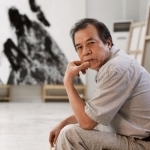
李涛和大多数中国人一样,至今依旧抱持着那份对“美好生活”的纯真向往,并总是乐观地享受着自己对“美好生活”的追求过程。亦如被誉为“都市史学家”的美国学者刘易斯•芒福德(Lewis Murnford)所言,“过美好生活的愿望”是人类之所以营造城市的本质因素, 故而李涛对于城市题材的迷执也就变得比较容易理解了。
李涛对于城市的理解是一个渐变的过程。90年代中从河南大学艺术学院毕业的他,从一个城市换到了另一个陌生的城市——武汉,在那里开始了为期三年的研究生就读生活。虽然所学习的专业并没有多大的改变,但是武汉相对于先前的开封而言就显得更加得嘈杂,而且生活境遇改变也让李涛更感受到了某种迁徙之后的不确定性。李涛同样将这些感受带到了创作之中,在那些关于城市的画面中散布着来自生活的各种片断,或者彼此冲突而间隔无序,并不呈现任何叙事的逻辑关系,或者结构封闭而色泽灰暗,直接反映了自己在生活中的沉闷、忧郁和不适。
三年研究生生活结束之后的李涛再次经历了另一场境遇的迁徙,他从武汉来到另一个更为庞大、更为嘈杂的城市——北京。90年代末的北京,正在无所畏惧地发生着天翻地覆的剧变,这令每一个初来乍到的“外来者”茫然无措。为了安身立命,白天的李涛是在一个建筑设计院中画着形形色色的建筑效果图,而到了晚上则“把桌子东西清了,拿着画笔抹两下,跟随着自己当时的心情随便画一画。”即便这些画作大多只有40×50厘米左右,亦如李涛所言是一些非常随性的画作,它们却可能更能反映出艺术家此刻的心绪——那种都市生活的融入意愿,以及由此所产生的惴惴不安。
2000年的李涛感到生活似乎变得渐渐“美好”起来了。这一方面是因为他已经越来越适应了北京的环境氛围,“在武汉天气基本是潮湿灰暗的,这和北京完全不一样,还有接触的人的精神面貌也不同了”;另一方面则是他找到了自己在都市中的位置,成为了北京广播学院动画专业的一名教师,“教动画专业,算特殊人才引进,反正也挺顺的”。都市的宽容也令他拥有了属于自己的创作空间,“2000年5月份过去以后,当时在学校对面,租了个平房当画室,有30多平米的画室,从那时开始能画一些画了。”对李涛创作更具影响的是计算机,这不仅成为了自我境遇的改善工具,“有时接点零活干干,给人家做个画册,画画效果图,挣点小钱”,更重要的是李涛觉得由此“有了一些新的经验和视觉体验”。
李涛回忆说,“1999和2000年这两年画了一批画,都是按自己的兴趣画,也没规模,也没系列,我感觉是在恢复状态”,但是“基本上这些东西,表现的内容还都是你生活的一部分,以及内心的一个状态”。从表面上来看这些作品都“有点计算机绘图以及印刷图像的那种感觉”,事实是李涛已经开始强化了某种秩序化的原则,刻意地去框定画面中的各种繁杂因素。
在随后的几年中这种倾向似乎变得越来越突出,即便“基本还是从自己的生活出发的”,但是李涛的意图却是要去“建构”针对都市生活的自我理解:“创作素材都来自杂志图片、网页截图”,这无疑源自艺术家针对信息化泛滥之下都市新形象的本质认识,正如戴瑞克•德科柯夫(Derrick De Kerckhove)的“文化肌肤论”中的阐释,“电子媒介爱抚着我们,并在我们的肌肤之下揉擦着其意义,为我们提供一种外在于身体和心智的‘精神’现实”; 而另一些关于室内空间的创作更类似于计算机设计中的三维建模,其方式似乎又来自于李涛日常工作经验的激励——“有些效果图荧荧光光的、粉粉的,非常好看,这也是对我新的刺激,然后就有愿望去表现它”,但在更深层面上所反映的却是当代都市生活越来越显见的现实虚拟化的趋势,以及这一趋势对于我们的心理状态所造成的深度影响。
作为一种延伸,2005年至2007年的李涛作品呈现出某种现实消融(liquidation)的特征:一方面,即便艺术家仍从所处的都市环境中选择适合表现的题材,但是这些创作具有明显的主观化的“建模”意图,即李涛所说的那种“有意地组织画面”的方式,由此转而强调画面中抽象性的空间构造,使得景物逐渐失去了应有的景深而仅作为画作构图的基本元素;另一方面,李涛也开始尝试着去“拼贴”,如《站立的人》,“我还在画面上贴上了竹叶,然后在画上几笔,真真假假地造成一种我认为比较适合的一种感觉”。于是“拼贴”,“在这里不单单是一种视觉的‘拼贴’,更是一种情绪和对事物认识的‘拼贴’,我觉得这种更有意思,跟我的体验和心理能够对应。”
2007年李涛在北京酒厂艺术区的一个画廊举办了一个题为“中产阶级的魅力”的个人画展。“中产阶级”无疑是都市人所谓“美好生活”的名称指代,而李涛的创作不仅仅是选取“中产阶级”的生活样本并进行了竭尽所能的图解,更以“卡卡”、“大奔”两个卡通人物为主角,直接将“现实消融”推导至“现实虚拟”的境地。
2008年以后李涛的创作,更像是以一种“沙盘演练”的方式来针对于“美好生活”的刻意模拟。在形形色色的“沙盘演练”的过程中,原先的“拼贴”开始转化为李涛所言的“代换”的创作观念——“当时我希望能用一种‘代换’的方法表达自己的感受,我也不知道更高级别的‘代换’是什么,就用真的材料代替。”譬如,“画面中的地砖瓷片我就是用真的瓷片切成小块儿。还有一件作品我要弄成破裂的玻璃的感觉,我反复把玻璃戳破,但是怎么弄都搞不成要的效果,就用了一个整玻璃,然后在上面画上裂痕。基本上用的是雕刻加绘画的方法,开始的时候办法很笨,后来方法慢慢就多了。”
而随着“代换”观念的生成,李涛的作品也从二维的平面逐渐转向了三维的空间。三维的中心要旨是渗透力和深度,而不仅仅是视觉的透视角度,事实上通过“代换”李涛的作品也逐渐地生成出了一种触觉性的环境。这是某种似是而非的奇妙观感,它一方面似乎有效地填补了虚拟与现实之间的巨大鸿沟,另一方面又激发起观者的想象力而保持着个人的自主力量,使我们能够把自己的意识投射于身体之外来“客观地”看上一番,正如戴瑞克•德科柯夫所言,“从二维到三维,再到触觉和强制反馈感觉能力的迅速发展,我们正在被一个有着丰富结构的虚拟化旋涡所吞没。”
李涛越来越强调城市作为我们视觉消费之对象的集体想象力,所以“代换”所带来的客观物质化是艺术家接下来必须面对的问题,于是“尺度”的向度而不是“风格形式”的向度即成为了李涛针对城市进一步思考的原则:李涛像一个空间建筑师般地通过不同的“尺度”构件进行着所谓的“营造”,“事先可以有一个规定的样式,但是也是大致的框架”。的确亦如李涛所言,“我对纯材料的探究是没有兴趣的”,“我希望能在作品中不仅仅是形式的雕刻和拼贴,而是包含了对文化、社会、商业等各种因素都揉进去。”在李涛不断“添油加醋”地融入各种因素的同时,“尺度”,既是一种对现实城市的解构方式,又是一种对虚拟城市的重建法则。于是,“城市”首先被肢解为分崩离析的片段,既而又在并置或排列下形成了完整划一的虚拟化的景观。
事实上面对这样的别样景观,每个都市人都会切身感受到那种迥异于当下城市之“伟大现实”的“缩小意识”。的确,“广大的尺度”是西方人基于希腊广场文化的城市实践,而“缩小意识”则是东方人在狭小空间中寻求寄托的传统向度。面对全球化所导致的同一性的肆意泛滥,李涛以虚拟性的手法复归至“小尺度”的精神凝聚,表达的却是针对“讲求细致精美的东方传统被破坏,精明的判断能力的荡然无存,美的感性意识最终走向残忍的行为,这般等等”的忧心忡忡。李涛的一切努力或许也都是在证明,所谓的“美好生活”并不存在于城市的本身,而在于每个人是否还存有那份超离现实的宁静内心。而李涛的作品也告诉我们,如果我们无法解放自己,那就让我们解放自己的视野,让我们通过艺术这一孔径寻求短暂的精神解脱。
Good life
Zhao Li
Like many Chinese, Li Tao holds a simple aspiration to good life and enjoys the process of chasing it. American “urban historian” Lewis Mumford attributes the establishment of cities to human desire of living good life and with his theory we can find Li Tao’s art easier to understand.
Li Tao had gone through a gradual process of understanding urban life. He obtained bachelor’s degree in the 1990s from Henan University, then went to Wuhan for his three-year master program. Though his major remains the unchanged, Wuhan is a bigger city compared with Kaifeng, where Henan University is located. The changed environment also imposes a kind of uncertainty to him. Li Tao incorporates all these feelings into his art, which reflects segments of urban life, some are in chaotic conflict with one other, following no narrative logic, while others are in a closed and gloomy structure, mirroring the artist’s sorrow, melancholy and discomfort.
When he obtained his master degree three years later, he faced yet another change of environment when he moved from Wuhan to Beijing, an even bigger and more dynamic city. Beijing in the late 1990s witnessed substantial and overwhelming changes, thrusting every comer into a state of instability. In order to make a living, Li Tao draws free image in a construction designing institute during day time, and “empties the desk to paint whatever emerges in the mind” at nights. These works measure only 40 by 50 centimeters, and are rather casual ones as Ti Tao puts it, but they are more capable of reflecting artist’s mentality – the desire to adapt to urban life and the accompanying anxiety.
In 2000 Li Tao seems to feel that the life is getting better. On one hand he has got accustomed to the weather in Beijing. As he puts it, “it is more damp and dark in Wuhan, which is completely opposite to that of Beijing. Besides, the people I encounter were in a different state of mind”. On the other hand, he secures a foothold at Beijing Broadcast Institute, working as a teacher in its Animation Department. He “was recruited as specialist or expert; that identity made many things easier”. At the same time he owned his first studio space. He recalled: “since May 2005 I rented a 30-square-meter house across the street as my studio. I could really do some paintings since then.” Computer plays a key element in Li Tao’s life, when he used it to improve his living standard. He said, “Sometimes I would do some part time jobs, design album and draw free image for others, in order to earn some money.” More importantly, from those practices he “gained experience and visual ability”.
Li Tao recalled: “I did some paintings in 1999 and 2000, which were not thematic or systematic. I totally followed my interest. It was as if I was recovering in art feeling. Basically those paintings depict parts of my life and mental status”. It seems that those works “resemble computer-assisted image and printed image”, while in fact Li Tao had began emphasizing certain order to organize each of the various elements within the frame.
This tendency becomes clearer in the following years. Although “still starts from life”, Li Tao shifts his focus to “construct” the understanding of urban life. The fact that “materials and inspirations come from images in magazines and websites” demonstrates his diagnose of the nature of urban life in the flood of information. As Derrick De Kerckhove holds in The Skin of Culture, electronic media caresses us, and under our skin transfuses meaning to us, establishing a ‘mental’ reality outside our body and soul. Other works depicting domestic space deprive their form from 3D modeling in CAD, which again leads to Li Tao’s working experience. He thought that “some free images look flashy; I am fond of them, and because of that stimulation I feel an impulse to express them”. However he manages to expose the trend of virtualization in urban life nowadays, as well as its impact on our psychological status.
As an extension, Li Tao’s works between 2005 and 2007 feature liquidation of reality: on one hand, although the theme is still artist’s urban life, the way it is organized has a strong intention of objective “modeling”, a way of “intentionally construct the surface”, therefore emphasizes abstract spatial framework of the paintings; on the other hand, Li Tao also tries collage, as is shown in Standing Man. He explained: “I stuck real bamboo leaves on the canvas, coupled with painted ones, mixing the real and the unreal to an extent I deem right. Collage here refers not just to the visual; it more concerns emotion and understanding of things, which I think is more interesting because it corresponds with my experience and mentality.”
In 2007 Li Tao had his solo exhibition “The Charm of Middle Class” in Jiuchang Art District. For people living in the city, “middle class” is the other name of “good life”. Li Tao does more than categorizing and demonstrating life of middle class; he goes further by pushing “liquidation of reality” to the threshold of “virtualization of reality” with two cartoon figures of “Kaka” and “Daben” created by him.
Since 2008, Li Tao seems to imitate “good life” by “sand table simulation”, during which process he replaces collage with the concept of “substitution” – he said: “I want to find a way to substitute existing approach. I do not know what to employ, so I used general materials. For example, I use real tiles to represent tiles in the painting, and in another instance I want to simulate broken glass in the painting, so I used glass shards to compose, but could not meet my expectation anyway. Then I decided to paint out the cracks on a whole piece of glass. Basically I add sculpting to painting, which is awkward at first, but later I find many ways to achieve it.”
With the formation of the concept of “substitution”, Li Tao’s endeavor switched from surface to space. The key of being three-dimensional is penetration and depth rather than visual perception. With “substitution” Li Tao’s works begin to form a tangible environment. The visual ambiguity bridges the gap between the real and unreal, and retains personal strength by provoke imagination of the audience, which allows us to move our consciousness out of our body for “objective” observation. Derrick De Kerckhove wrote: “From two-dimension to three-dimension, and further to fast growth of the sense of touch and compulsive response, we are being consumed by a virtual swirl which has a complicated structure.”
Li Tao stresses the collective imagination required for including city in our visual consumption. Consequently, he has to deal with the issue of materialization. As a solution, Li Tao employs the dimension of “scale” rather than that of “style” in guiding his art: he constructs his work with components of various “scale”, like an architect. He thus confesses: “I start with a given pattern or a preliminary structure. What interests me is not study of material but incorporate cultural, social and commercial elements into my art, in addition to sculpture and collage.” While he adds these elements, “scale” assumes the double task: deconstructing the city and reconstitutes a virtual one. As a result, city is first dismembered into fragments, and then rearranged to form a single spectacle.
Such an alternative spectacle is a “shrinking consciousness” compared with the popular urban “expansive reality”; while the later originates from plaza culture in ancient Greece, the former finds its root in oriental tradition of seeking spiritual relief in confined spaces. Faced with the homogeneity brought about by globalization, Li Tao redirects to mental concentration of “small scale” with the manner of similarity, and expresses his worry for “the destruction of oriental tradition that values the beauty of daintiness and subtleness, the lost of precise judgment, and the deterioration of aesthetic mentality into brutality”. Li Tao’s effort may be trying to prove that the so called “good life” actually does not exist in city, but exist in the hearts of the people with disinterested and serene mentality. He also tells us with his art that if we cannot free ourselves completely, we can at least unleash our vision and might be able to enjoy a moment of liberation through the aperture of art.
【编辑:霍春常】





 京公网安备11010502038436号