


黄笃:谈谈你对摄影的真实性的看法,这是一个很重要的问题。
缪晓春:摄影术是为着记录客观真实的目的而发明的,但在使用这个媒介时,却首先会发现摄影并不完全是客观真实的记录手段。摄影只能框取天上人间大千世界中一定宽和一定长的某个局部,这既是它的局限又使得它因此能强调某一部分景物的重要性及其隐含的寓意;摄影只能定格流动着的时间中的一瞬,但它使这一瞬变成了永恒。黑白摄影是不真实的,但它又使缤纷的五彩世界抽象地转化为黑白灰,呈现给我们一个异样的世界,给我们一份惊喜。
摄影的不真实不仅由于技术层面上的原因,更多的还因为我们拍摄时的主观选择。当我们举起照像机试图去拍摄一个场景的时候,我们肯定是在运用某一种观念在指导我们的手指,否则我们为什么会对着这一个场景而不是另一个场景,是在这一瞬间而不是在另一瞬间按下快门?即使是毫无目的的拍摄,也隐藏着某种观念,也许旨在表明“我们的主观选择是错误的,我们要抛弃它”这样一种观念。只要是摄影就离不开选择,而所有的选择都是跟我们的主观有关联的,都是为某种观念所引导,从这个意义上来说,所有的摄影都是观念摄影,都带着不真实的主观的以至于强迫的色彩。反过来讲,再怎么观念的作品,都是用照像机和胶片在记录下某种设定的场景,或者是从生活中截取的一个片断,即使改头换面到难以辨认的程度,它总是客观生活的一个翻版和记录,从这个意义上来说,所有的摄影包括我们现在所指的观念摄影都是带有某种记录性的。只不过为了讨论问题的方便起见,我们把摄影用并不精确的词语作了分类,分成纪实摄影、观念摄影等等,这是我们所使用的语言的缺陷,而在我们思考问题的时候,是绝对不能把两者截然分开,甚至相互对立。正是摄影的这种将客观记录和主观选择结合在一起的既矛盾又统一的特征加强了摄影作品的表现力度。我们借此或直截了当或曲折含蓄地表达了那些虽然用语言等其它媒介也能表达但不够全面,或者根本无法用语言来传达的思想、观念和情感,这就是摄影的力量所在。
黄笃:这样一来,拍摄者主观的观看方式就变得非常重要了。
缪晓春:对,从一开始,摄影便让我处于某种尴尬之中:一方面,它记录细节的能力让我惊讶,许许多多我用眼睛在现场没有看到的东西,照相机都看见了,清清楚楚,纤毫毕现。 这常令人窃喜,好像照相机的能力暗暗转换成了我的能力;另一方面,照片明显地丢失了我在当时现场所感受到的,所想象过的许多东西,相机所见与人眼所见相差竟然如此之大,这又常令人恼怒,于是我一直在想,照相机丢掉了哪些东西呢?
第一, 它仅仅是机械的,光学的观看,没有思想,没有感受,没有情绪。它本身是一个工业产物,用德国的照相机“观看”与用日本的照相机“观看”的结果不会产生本质上的文化上的差异,而用我的眼光去看的话,我眼睛的后面是大脑,装着这样那样的文化的历史的个人的观点;反过来这必然是会影响到我观看的方式。于是在1999-2004年间做的带有一个古人雕像的系列作品,便是这样一个尝试,让“他”作为一个中介或桥梁,让一个普通的观看行为过渡为一个“历史的观看”或“文化的观看”。
第二, 照相机不会有选择地观看,而我一直在现场发现、寻找和筛选我观看的兴趣点。我可以连续几天在同一个地点观看并拍摄,然后把我在这同一个地点所看到的各种有意思的我感兴趣的东西集合在一起。为此我改变了透视,只是为了容纳进更多的观看的内容。改变了时间,改变了光线,让一切变得似乎恒久一些。对于新闻记录照片而言,也许有一个禁忌,那就是观看的角度和拍摄的时机都可以主观选择,但由照相机所记录下来的图像是万万不能再擅自加以改变了!这是绝不可跨过的一条界线。
第三,镜头的记录方式也从来让我充分满意过,它经常是“顾此失彼”。当它能清清楚楚地“看”到远处景物的细节时(如望远镜头),它必然是对周边的景物“视而不见”的,当它能摄取所有的景物时(如鱼眼镜头),它的边缘又必然会弯曲变形夸张得令人“惨不忍睹”,于是我必须花很多的时间去弥补镜头观看能力的不足,让它按照我的方式去观看。否则我便会被强行修正成按镜头的观看方式去看世界。
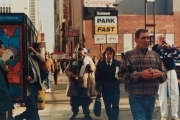
而对我而言,不但观看的角度,拍摄的时机,所有的一切都可以改变,我不想改变的是细节的真实,因为这是照相机最擅长的,最能表现出摄影的力量的,因而也是我最不愿改变、最想花最大的力气去获得和保留的。所谓花最大的力气去获得,那就是在拍摄的时候用极笨重的8×10胶片相机,以获取在现阶段摄影技术所能获取的最多细节;所谓花最大的力气去保留,那就是在后期的电脑处理中,尽可能保留所有细节的合理性,不因用Photoshop而丧失了细节的真实性。所以在“Await”中,所有的人都是在现场拍摄的,但所有的人又都是重新排列组合的,它们的排列方式在照相机看来是不合理的,因为他们没有在同一快门时间出现。而在我看来是合理的,因为我确实在一段连续的时间里看到这些人的出现和散去。
我说话的时候,照相机沉默了,否则必然拍摄者沉默了,照相机在说话,这就是主观的观看。
黄笃:于是,你的摄影中便出现某些经常让人疑惑的地方:从整体上来说它似乎是完全真实的,但仔细推究一下,却总能发现某些超乎一般意义上的真实的地方,真实到有点过头,有点虚假的味道,而这是你整合了你主观的设定和摄影对客观真实的记录能力来达到的。
缪晓春:是,这是我想用摄影这个媒介想达到的效果。
Huang Du: Let’s talk about the truth of the photography, it’s a very important issue.
Miao Xiaochun: Photography was invented for the purpose of recording objective truth. However, while using this medium, we will discover that photography does not completely record reality. Any photograph can only depict a certain section of the world, with a certain width and a certain length. This is not to be considered solely a limitation, for it can be used to emphasize the importance of a part of the scene and its implied meanings. Photography can only record a split-second record of time; nevertheless, it makes that second eternal. A black-and-white photograph may be untruthful, but it transforms the colorful world into black, white, and gray in an abstract way, presents us with an unusual view of the world, and can bring us much joy.
Photography’s untruthfulness arises primarily from our subjective choices. When we hold up a camera to photograph a scene, it is guaranteed that some concept is guiding our fingers. Otherwise, why is this scene, and not another scene, to be photographed? Why is the shutter pushed down at this split second and not another? Even a photograph taken without any obvious purpose might express the concept that subjective choice is wrong and should be abandoned. Choice is always involved. From this perspective, all photography is conceptual photography. On the other hand, even if a photograph is a conceptual work; it still records something with camera and film. Even if the appearance is changed and it is difficult to recognize, it still records something in the world. Thus all photography, including our so-called conceptual photography, is at one level documentary. We only divide photography into inaccurate categories for the convenience of discussion; in actuality these two cannot be separated, nor are they antagonistic. Photography combines objective recording and subjective choice, which intensifies the expressive power of the work. We use this feature to either directly or indirectly express thoughts and feelings that might only be incompletely expressed by language or through some other media, or that cannot be expressed by language at all. This is the power of photography.
Huang Du:So the subjective looking in your photography will be crucial.
Miao Xiaochun: Yes! From the very beginning, the photography made me feel myself in a certain dilemma: On the one hand, I am surprised at the details recorded by the camera “who” has seen all those things that I couldn’t see on the spot with my eyes, very clear, distinct in the minutest details. This often makes me secretly pleased, for it seems that the ability of the camera has been secretly transformed into my ability; on the other hand, the picture has obviously lost what I felt and what I imagined while I was viewing the scene on the spot. Such a nasty difference between what the camera sees and what the human eyes see often makes me angry, so I have never stopped thinking about what the camera has discarded finally.
First, it is merely a mechanical and optical looking; the camera has no thought, no feeling, no mood. It’s itself an industrial product, there is no fundamental or cultural difference at all between looking with a German camera and looking with a Japanese camera, the result shows just the same. But while I look with my eyes, behind my eyes is my cerebrum which has stored up such and such cultural, historical and individual viewpoints that in turn will inevitably affect my way of looking. Then there was the attempt to make a ancient statue and put it in the series of my works made during 1999-2004. Through “him” considered as an intermediary or bridge, an ordinary looking was transformed into a "historical looking" or "cultural looking".
Secondly, the camera cannot look with choice, but I keep discovering, seeking and selecting in the scene every interesting spot to me myself. I can look and photograph during several days in the same place, and then I gather together all the interesting things I have seen in the same place. Therefore, I changed the perspective, and this is only for containing more of what I saw. I changed as well the time and the light, to make everything look somewhat permanent. Perhaps there is some taboo for news photos: one is free to choose the point of view and the time or opportunity to take a photo, however, one can never be allowed to change arbitrarily the image which has been recorded by the camera! This is the bounds which cannot be surpassed.
Third, I have never been completely satisfied with the record way of the lens, which often “attends to one thing and lose sight of another”. When it can “see” very clearly the distant details (for example telephoto lens), inevitably it “looks but not sees” the peripheral scenery; and when it can shoot all sceneries (for example fish eye lens), its edge will inevitably bend and become so deformed that it is “too horrible to loot at”. So it takes me a lot of time to make up for the insufficient ability of looking of the lens, to let it look in my way. Otherwise, it is my myself who will be corrected and forced to look at the world in the way of the lens.
But in my opinion, not only the point of view, the time to shoot, but also all can be changed. What I do not want to change is the authenticity of the details, because this is just what the camera is most skilled in. It is the authentic details that display really and finally the power of photography, and therefore constitute what I am not willing to change and always try to catch and keep. Try to catch means to use an extremely unwieldy traditional 8×10 film camera to capture details as many as I can with the existing photographic technology ; try to keep means to try to keep the reasonability of all details during the later computer processing and not to lose their authenticity with Photoshop. Thus in "Await", all people were photographed in the scene, but they were all rearranged in the picture. Their arrangement way looks like unreasonable for a camera, because they didn’t appear at the same shutter time. But for me, it is reasonable, because I did see in a consecutive period of time all these people appear and then disappear before my eyes.
When I speak, the camera keeps silent, and vice versa, this explains the subjective looking.
Huang Du: So, there are often amazing and puzzling points in your photography:generally speaking, or from the point of the whole image, it seems totally true, but after scrupulous study, we can always find out here and there some “supertruth”, a certain truth beyond the extremity, a truth which smells even false, and this is the result you have achieved through the combination of your subjective assumption and the objective record ability of the camera.
Miao Xiaochun: :Yes, this is just what I want to do with this medium.
【编辑:小红】







 京公网安备11010502038436号