


再一次,王音的绘画在这个焦虑的时代给人们带来了某种清新之感。这颇出乎一些人的意外。在北京东郊一座用青砖建成的号称“艺术仓库”的展厅里,四壁挂有王音近年来七、八幅绘画作品和装置作品,主题就叫“在那里”。没有刻意的求新,没有吓人的架势,初看上去那些作品甚至显得有些陈旧,然而这种“陈旧”却有一种特殊的吸引力,使人恍然有“如归故里”之感。我去看这个展览时,正值盛夏的一场暴雨,瓢泼大雨就在我们刚刚进入展厅的门廊后倾泻下来。那好,就让我在风声雨声中和这些作品静静地待在一起。艺术无论新旧,问题只在于它是否“到家”。现在,我们到“家”了。
王音是性情中人,为人又很儒雅,朋友们常戏称他为“学院派”。这当然不单是指他的学院背景,或他的书读得多,富有人文素养,从内里来看,指的是在他那里体现了一种成熟的富有历史感的艺术意识。正是他的“历史感”在决定着他怎样来建构自己的艺术。在这一批作品之前,王音曾雇了一个农民画匠,他不无“粗暴”地把他的油画人物或现代风景(如“沙尘暴”)覆盖在这位农民画家的艳俗山水上(那种我们在乡土中国的饭店、餐厅里随处可见的所谓“山水画”),或是迫使他的农民画工按一种陌生的西洋画的透视法来画大片的牡丹,使传统的中国民间美学以一种荒谬的方式绽放着。王音的这个系列,正如汪民安所说“是绝对的差异性嬉戏”,其意义“不是创造一种新的绘画,而是为了批判既存的绘画……是为了将绘画传统的神话和权力属性暴露出来”。这种方式的确使人惊愕,甚至困惑,但却迫使人们反思。王音达到了他的目的。在重新通向绘画之前,他必须在一个更开阔、长远的历史视野里重新打量和思索艺术本身。
这一次王音又出奇制胜,以另一种迥然不同的方式。他完全绕开了当今绘画和艺术界所热中的那些东西(他太了解那些东西),而又“以故为新”。在当今这个所谓“日日新”的时代,谁还记得索尔仁尼琴是谁呢,然而,王音就从这里再次开始。大幅喷绘油彩《伊万•杰尼索维奇的一天》,令一些观众不知所云,因为他们不知道这个人是谁。伊万•杰尼索维奇是谁?——索尔仁尼琴在四十多年前引起巨大轰动的成名作《伊万•杰尼索维奇的一天》中的人物。小说叙述的是伊万在集中营里服刑劳动的一天,而王音的作品,并没有直接描述这种内容,相反,他取的是 “俄国的荷马”(这是阿赫玛托娃对索氏的评语)在花园里繁花似锦的树阴下的桌子上写作的一幅照片,并对它进行喷绘油彩处理。这样,画面上美丽、静谧的花园和作家写作时的那种深邃的寂静,就与《伊万•杰尼索维奇的一天》这个画题名形成了巨大反差,而这恰恰是震撼人心之处。我早就听王音说他要用索尔尼仁琴的这篇小说来做一个艺术作品,但没想到他是以这种方式来做!而这样做,真是再好不过。因为他要做的不是复述历史的苦难,而是要呈现现时与记忆、艺术与生活、个人与历史之间的那种张力关系。从一个集中营里的幸存者,到拿起笔来见证这一切,从冰天雪地中的苦役,到夏日花园的深邃和宁静,从成千上万历史的无辜的牺牲品,到一个在写作中进行追忆的个人……王音就这样使我们“在最短的句子间走过了历史”,因而画面中那宁静、深邃的“现时”,恰如一种如枪响般震动人心的宁静!它给人一种“此身虽在堪惊”之感。
对生存的“梦里不知身是客”这种古老悠久的感受,结合了现代历史的暴力,这使王音的这件作品产生了异乎寻常的力量。我不知索氏的小说王音当年读时对他产生了什么样的作用,但我完全能够窥见到他现在的心境。坐在树阴下的是谁?是一个沉浸在写作中的叫索尔仁尼琴的俄国作家吗?这样问已没有意义。我感到的只是,以这种方式,王音进入了他的个人经验和记忆,进入了艺术的最隐秘的内核。只有找到并确立这个位置,艺术才有了它的空间和意义。
也可以说,以这种方式,王音把历史个人化了。不仅以个人来见证历史,而且以历史来阐释个人。和当代艺术中那种重塑公共记忆的流行做法很不相同,王音的这一批作品大都是从个人经验和记忆入手。多年来在他身上发展、深化的个人意识,使他拒绝艺术成为历史的简单符号。那种把历史表面化、符号化的做法也很难说能够真正地切入人生。这就是为什么他的《鲁迅公园》这幅油画里没有鲁迅塑像之类,没有任何和伟人相关的东西,只有树丛和草地,只有树林间筛落下来的光与影,只有那从草地和树梢间荡漾而过的风。它看上去就像是一幅印象派的风景画,但这却是和王音的人生经历深刻相关的风景:他画的是青岛鲁迅公园的一角,他就是在那里长大的。因此他会这么动情地一笔一触地画那些草地和树木,仿佛童年的喧声就从那里再次响起,仿佛当年踢出的球仍在那里等着他去捡拾。画面上没有历史,但这就是历史。他以这种“闹中取静”的方式在人生与历史之间重建了一种关系。
和《伊万•杰尼索维奇的一天》一样,《鲁迅公园》这件作品的“画面”(所描绘的事物)与标题之间也是一种很不寻常的关系。他画的是“鲁迅公园”,鲁迅是二十世纪中国历史充满暴力和创伤的文化象征,王音这一代恰好又是在把鲁迅革命化的年代成长起来的。然而“鲁迅”却不在这幅画里。这意味着表述历史其实还有着另一种方式:使它缺席,使它以缺席的方式在场,使它以某种更内在的方式切入绘画。这正是王音的高明之处。“历史”不在画面上,但它“就在那里”。当然,这不是在玩“在与不在”、“能指”与“所指”的游戏,王音不是这样的玩家,但作为一个深受中国人文传统浸润的艺术家,他知道什么叫“空”及它的功能。他画的是“空”,是“静”,是“一片白茫茫大地真干净”,但却唤起了人们对历史和人生的无限的感怀和追忆。
展览上两幅以“无题”为题的“抽象画”,也是这样。这两幅画的颜料色块都不是用画笔而是用弹弓弹上去的,但这却不是为了刻意“探索”什么,据王音讲,是因为抽象派绘画在世界上大行其道的时候,他正在玩弹弓。现在,多少年后,他想用这种方式找回当年那个顽童(或者说,当年那个孩子弹出的东西,终于穿过了茫茫时空,落在了一幅画上?),想以此把两种不同阶段的人生、把历史(这当然也包括了艺术史)和个人记忆粘连在一起?今天,用弹弓作画的艺术家已不同于当年的那个孩子,似乎在“弹指间”,从时间中就升起了烟雾茫茫。这使我们不由得感叹人生,也使我不能不佩服我们的艺术家,他用这种看似玩闹的方式,却向时间和空间投出了最深邃的一瞥。
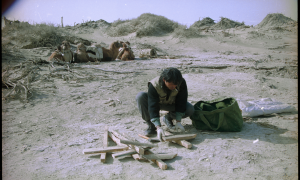
写到这里,我们可以看得更清楚了,那就是王音愈来愈倾向于成为一个“为人生”的艺术家。只不过他的为人生绝不是表面化的,从内里来看,他总是着眼于困扰着人生的那些更内在的问题,油画《野火烧不尽,春风吹又生》又是一证。一句几乎被人们用滥了的古诗,被用于这件作品,却获得了感人的力量,因为王音把一种对自然现象的描述,变成了对精神本体的书写。画面上的人物,呆坐在荒坡之中,似乎有什么在他身上死去,又有什么在迷茫中醒来,一切都在随着造化的力量一起生死蜕变。王音的人物似乎从来就是这样,不是工笔的,而是写意的,并且总是带着一种愚笨的、迷茫的意味。他有着《彷徨》式的找不到出路的苦闷和茫然,又带着基弗式的深度个人幻灭意识,只不过这一次,他却在准备着自身的死亡与再生的庆典。他被赋予了王音个人的独特印记,但在某种意义上,又是一代人的精神肖像。这就是王音的艺术,在他的作品中,“个人的”从来就是“历史的”,“语言的”也就是“文化的”。
三件以“冬妮娅”为题的灯箱装置作品,也承载着一个时代的记忆。它暗含了一个中国少年成长的故事。这几件作品,不用说,是取自《钢铁是怎样炼成的》小人书(即“连环画”)。值得留意的是王音对过去时代文本的态度,它不是一种后现代式的消解和调侃,不,他对它们充满了比这一切更深厚的温情。他那适度得体的反讽和幽默感,也伴随着一种自我的追悼,因为它们曾是人生的全部寄托。我甚至认为这类早年的秘密读物比后来的任何书籍都更深远地影响了王音的一生——从他早期的“新青年”绘画系列和现在画的人物,几乎无一不带着这种“小人书”的痕迹。现在,他直接把这类小人书变成了“中年写作”(这里借用诗歌界的一个说法)的资源,变成了一种人生的挽歌。是啊,对王音来说,是到了“怀旧”的时候了。只不过这种王音式的怀旧,总是意味着比这个词本身更深厚、也更耐人寻思的东西。
这就是王音的“在那里”。这一切使我相信了他的一句话:“画画终究是一项极朴实的工作”。这又使我想起了海德格尔的一句话:“思想是一件手艺活”。一个将一生奉献给艺术而又抵达到它的内在本源的人才会如是说。近一、二十年以来,艺术圈里的人们已被“对新奇的无休止的迷恋”弄得疲惫不堪,而他们所追求的一切仍如羚羊挂角无迹可求。正是在这种背景下,从王音的这句话里,我窥见了一种心路历程;因为他的这一批作品,我们也应对艺术有新的发现和领悟。严羽论诗云“学诗有三节:其初不识好恶,连篇累牍,肆笔而成;既识羞愧,始生敬畏,成之极难;及其透彻,则七纵八横,信手拈来,头头是道矣”。毫无疑问,王音正以他极朴实、智慧的方式进入了这后一个阶段,这使我们有理由对一位艺术家抱有更大的期待——当我在那个清凉、昏暝的“艺术仓库”里这样想时,雨,更猛烈地下下来了。
2003年9月
It”s Right There
On Wang Yin”s paintings of recent years
By Wang Jiaxin
Once again, Wang Yin”s paintings have brought to us something refreshing in an anxious age, which is quite a surprise to some people. In the exhibition hall of a so-called "Art Warehouse" built with gray bricks on the eastern suburb of Beijing, Wang Yin”s seven or eight paintings were hung on its walls, together with his installations. The title of the exhibition was "Right There". There was no deliberate attempt at novelty or intimidation. Those works seemed to be somewhat obsolete at the first sight; however, this "obsolescence" possessed a particular appeal, providing a sudden "home-coming" enlightenment. When I visited this exhibition, there happened to be a rainstorm in midsummer. Heavy rain was pouring right after we walked past the porch of the exhibition hall. Alright then, let me stay quietly with these works with the sound of rain and wind. Be it old or new art, what matters is whether it "is perfect at home." Right there with Wang Yin”s works, we have arrived perfectly "at home."
Wang Yin is a spontaneous person and has an amenable temperament. Friends teasingly categorize him as "the academic type." It certainly not only refers to his academic background or the fact that he reads a lot, or that he is full of humanistic quality. On a deeper level, it indicates an advanced understanding of art that is full of historical perception. It”s his "historical perspective" that determines how he develops his art. Prior to this group of works, Wang Yin had worked with a painting artisan who was a farmer. He violently painted portraits and modern landscapes (such as that of "sandstorm") on top of his peasant painter”s kitschy landscape paintings (those so-called "landscape paintings" that we frequently encounter in rural hotels and restaurants in China). Or he forced this very peasant painter to paint fields of peony blossoms with the perspective in Western painting that he was unfamiliar with so that the aesthetics of traditional Chinese folk art was presented in an absurd way. This series of Wang Yin”s paintings, according to Wang Min”an, "was an absolute play with the otherness," and its meaning "didn”t lie in inventing a new painting, but in critiquing existing paintings...and in exposing the traditional myth and power nature of painting." This approach was indeed astonishing, and even confounding, but it forced people to think. Wang Yin accomplished his aim. Before re-leading to painting, he had to re-examine and contemplate art itself in the context of a broader and more long-termed historical perspective.
This time around, Wang Yin has made an impact by surprising us once again, in an entirely different way. He has steered clear of those things that the painting circle and the art world are obsessed with (He knows about them too well), and "recycled the old as if they were new." Who would remember Solzhenitsyn in a time that changes constantly? However, that”s exactly where Wang Yin has picked it up again. Large spray painting "One Day in the Life of Ivan Denisovich" has confounded some audience since they have no idea who he was. Who was Ivan Denisovich? He was a character in Solzhenitsyn”s name-making masterpiece One Day in the Life of Ivan Denisovich, which made a big stir more than 40 years ago. The novel described one of Ivan”s days laboring while serving his terms in the concentration camp, while in Wang Yin”s work, there was no direct depiction of this content. On the contrary, he took the image from a photograph of the "Russian Homer" (which is a description of Solzhenitsyn by Akhmatova) writing on a table under the full-grown shade in the garden and gave it the treatment of spray painting with color paints. Thus the beautiful and peaceful garden and the profound quiescence of the writer absorbed in his writing formed drastic contrast with the title of this painting, "One Day in the Life of Ivan Denisovich," which was precisely what was striking about this painting. I had heard from Wang Yin long ago that he would make a work based on this novel of Solzhenitsyn, but I had not expected him to do it in such a way! There was no better way than his! What he wanted to achieve was not to repeat the hardship of history, but to demonstrate the tensional relationship between the present and memory, art and life, the individual and history. From a survivor of the concentration camp, to someone who testified to all of this with a pen, from the hard labor in a world of ice and snow, to the tranquility and calmness of a summer garden, from thousands of innocent victims of history, to someone who tracked down memory in his writing...Wang Yin invites us to "go through history within the shortest sentence," thus the peaceful and profound "present" in the image is like a kind of peace that shocks the calmness of the heart like a gun shot. It generates a sense of "being present yet still shocked".
The ancient and everlasting feelings of "displacement" in life, coupled with the violence of modern history gave Wang Yin”s work an extraordinary force. I have no idea what kind of impact Solzhenitsyn”s novel had on Wang Yin back then, but I can completely understand his present state of mind. Who was sitting under the shade? Was it a Russian writer called Solzhenitsyn”s who was absorbed in his writing? It”s already pointless to ask such questions. What I can feel is that in this way, Wang Yin has become involved in his personal experience and memory, the most hidden core of art. Only when he has found and secured this position can art have its space and meaning.
Or we can say that Wang Yin has personalized history in this way. Not only has he had history witnessed by an individual but he has also interpreted the individual with history. Unlike the popular method of reconstructing public memory in contemporary art practice, this series of Wang Yin”s works has developed from personal experience and memory. The individual awareness that he has developed and deepened over the years has made him refuse to turn art into simple historical icons. The way of symbolizing and reducing history to the superficial is hardly able to really connect with life. That”s why there was no Lu Xun statue in his oil painting "Lu Xun Park," neither was there anything related to this great master. There were only trees and grassland, only light and shadows filtrated by trees, only wind going through the grassland and tree trunks. It looked like an impressionist landscape painting, but this was a landscape that was deeply linked to Wang Yin”s personal life experience. What he painted was a corner of Lu Xun Park in Qingdao, where he grew up. Thus he depicted those grass and trees with such emotions, as if his childhood had come back to life again, as if the ball that he kicked off back then was still waiting there for him to pick up. There was no history on the painting but this, was history. He re-installed a relationship between life and history in a way that was "gaining calmness from commotion."
Like "One Day in the Life of Ivan Denisovich", the content of "Lu Xun Park" (what it depicted) also had an unusual relationship with its title. What he painted was "Lu Xun Park". Lu Xun was a cultural icon of the 20th century Chinese history, which was full of violence and trauma. Wang Yin”s generation happened to have grown up in the age that revolutionized Lu Xun. However, "Lu Xun" was not in the picture. This means that there is another way to narrate history: by making it absent. It was present through its absence so that it was related to the painting in a more inherent way. This was where Wang Yin”s talent lied. "History" was not in the picture, but it was "right there". Of course, he was not playing the game of "being present and absent," the "signifier" and the "signified" Wang Yin didn”t play it this way. As an artist deeply schooled in Chinese literati tradition, he knows what is called "emptiness" and its function. What he painted was "emptiness," "quietness," and "a vast expanse of whiteness and the land was very clean," but he succeeded in recalling people”s indefinite sentiment and retrospect of history and life.
Another two "untitled" abstract paintings in this exhibition were done in the same way. The color patches on these two paintings were not painted with a brush but flipped onto the canvas with a catapult. This was not a deliberate attempt to "explore" a certain technique. According to Wang Yin, when abstract painting was extremely popular around the world, he was playing with catapults. Now, many years later, he wanted to discover the naughty child from that time. (or in another word, what the boy had flipped back then with a catapult, eventually landed itself onto a painting after having traveled through a vast expanse of time and space?) Thus he intended to have two different stages of life, history (which certainly included art history) and individual memory strung together? Today, the painter that painted with catapults is no longer the same as the child back then. It seemed that everything vaporized in a blink. We can”t help feeling sentimental about life. I can”t help admiring our artist, who has cast the most profound glance towards time and space in a seemingly playful manner.
At this point, we can see it more clearly that Wang Yin is leaning more and more towards becoming an artist "for life." It”s only that his relationship to life is not a superficial one. He is always interested in those more inherent issues that upset life. His oil painting "Those Burnt by Wild Fire Are Brought Back to Life by the Spring Wind" is another example. A worn-out line of ancient poetry is applied to this work and thus gained an affecting power. Thus Wang Yin turned a description of natural phenomena into that of the spiritual. The figure on his painting was sitting transfixed in the midst of a deserted slope. It seemed that something on him had disappeared; while something else woke up in confusion. Everything was coming and going, being shaped by the force of the Nature. But Wang Yin”s character seemed to be like that all the time. It was not depicted in Gongbi, with extreme detail. It was abstract, always with a stupid and confused impression. He had the kind of anguish and loss over the failure to find a way out as depicted in "Straying." He also had a Kiefer-esque sense of profound personal disillusion. But to a certain sense, it is the spiritual portrait of a generation. This is Wang Yin”s art. In his art, "the personal" is always the "historical," the language is always the culture.
Three light-box installation works all entitled "Tonia" also bore testimony to the memory of an era. It implied a story about the growth of a Chinese teenager. These couple of works was clearly based on the comic strip, Kak zakalyalas stal. What is worth noticing is Wang Yin”s attitude towards materials from the past era, which is not one of postmodern negation or ridicule, no, he is full of deeper emotion towards them than all of this. His moderate irony and sense of humor are coupled by a kind of self-mourning, because they were once where people found all their sustenance. I even find these early secret readings to affect Wang Yin”s life in a much more profound way than the later books he”s read - from his early "New Youth" painting series to the current portraits unexceptionally bear the marks of this kind of "comic strips." And now he”s directly turned comic strips into the sources of inspirations for "mid-age writing" (to borrow a term from the poetry circle), a eulogy of life. Yes, for Wang Yin, it”s time to be "reminiscent." Only that Wang Yin”s style of reminiscence always means something more profound and more thought provoking than the word itself.
This is Wang Yin”s "Right There." Everything makes me believe in one thing he”s said, "Painting is ultimately an extremely down-to-earth act." This reminds me again of one of Heidegger”s sayings, "Thinking is craftsmanship." Only someone who devotes his entire life to art and arrives at its inner essence would say so. In the last decade or two, people in the art circle have been worn out by the "endless obsession with the new and exotic," yet everything they are after is still as rare as antelope horns. It”s exactly in this background that I detect a state of mind from Wang Yin”s sentence. Thanks to this series of works of his, we should have new discovery and understanding of art. Yan Yu wrote of poetry, "There are three stages for studying poetry: initially, not knowing what”s good or bad, one writes a lengthy and tedious poem until he puts down his pen. Then he begins to feel ashamed, and have respect for it and discovers that it”s very difficult to write. After he fully grasps the skill, he can then write freely, write anything and makes sense of everything." Without doubt, Wang Yin has entered the later stage of his practice in his own very down-to-earth and wise way. This gives us reasons to have greater expectation of an artist - when I had these thoughts in that cool and gloomy "art warehouse", the rain, came down even heavier.
September 2003





 京公网安备11010502038436号